

Machine Learning and Artificial Intelligence in Smart Manufacturing Systems
Dr. Denis Jankovič, mag., doc. dr. Miha Pipan, univ. dipl. inž., prof. dr. Niko Herakovič, univ. dipl. inž., vsi Univerza v Ljubljani, Fakulteta za strojništvo
Ventil 32 (2026) 2 / Review articles / Technical article – 1.04
Abstract:
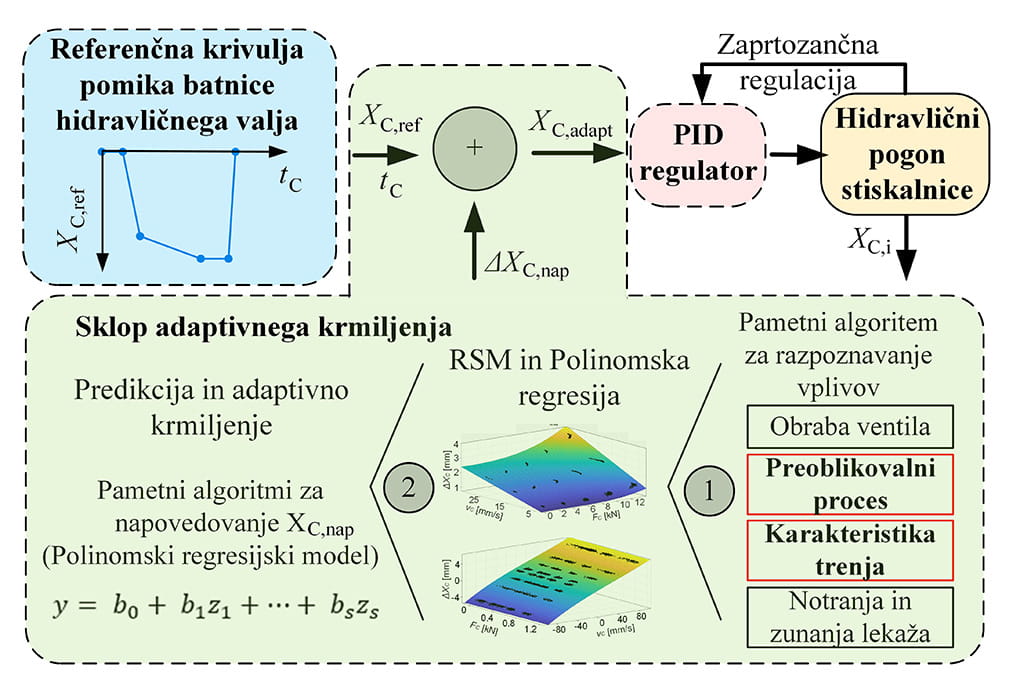
Artificial intelligence and machine learning are increasingly shaping the development of modern smart manufacturing systems, where reliable and efficient operation is strongly dependent on accurate awareness of machine states and process conditions. In this paper, the practical applicability of data-driven methods is demonstrated through a representative case study of a hydraulic press used in sheet metal bending operations. Based on this system, a comprehensive monitoring and analysis framework was developed, combining systematic process data acquisition with regression-based machine learning models to enable advanced insight into press behavior under diverse operating regimes.
The experimental investigation covers a wide range of scenarios, including varying forming forces, hydraulic cylinder velocities, and controlled simulation of friction effects in the cylinder guide system. Five key process parameters were identified as dominant inputs and used for a comparative evaluation of several regression approaches. The results show that linear regression, Support Vector Machines, and Gaussian Process Regression achieve superior predictive performance, with coefficients of determination exceeding R² = 0,99 across all evaluated operating phases. At the same time, the analysis confirms that simpler models offer significant advantages in terms of training time and computational efficiency, which is particularly important for real-time industrial applications.
The proposed approach enables continuous detection of operational deviations, achieves up to a 95% reduction in hydraulic cylinder response error, and establishes a solid foundation for real-time adaptive control strategies. By integrating machine learning models into the control and monitoring architecture, the presented methodology contributes to increased robustness, responsiveness, and transparency of hydraulic forming systems. As such, it supports the development of intelligent, data-driven manufacturing solutions aligned with the principles and objectives of Industry 4.0 and Industry 5.0.
Keywords:
Artificial intelligence, Machine learning, Hydraulic systems, Expert systems, Digital twin
Copyright (c) 2026 Denis Jankovič, Miha Pipan, Niko Herakovič
This work is licensed under a
Creative Commons Attribution 4.0 International License.
Except where otherwise noted, articles in
this journal are published under the
Creative Commons Attribution 4.0 International License.