

Development of Energy-Consumption Digital Twins for a Discrete Production Lines
Dr. Miha Glavan, univ. dipl. inž., Institut Jožef Stefan, Rok Struna, inž., Rudolfovo – Znanstveno in tehnološko središče Novo mesto, Vinko Longar, mag. inž., Rudolfovo – Znanstveno in tehnološko središče Novo mesto,
dr. Dejan Gradišar, univ. dipl. inž., Institut Jožef Stefan
Ventil 32 (2026) 2 / Review articles / Scientific Article – 1.01
Abstract:
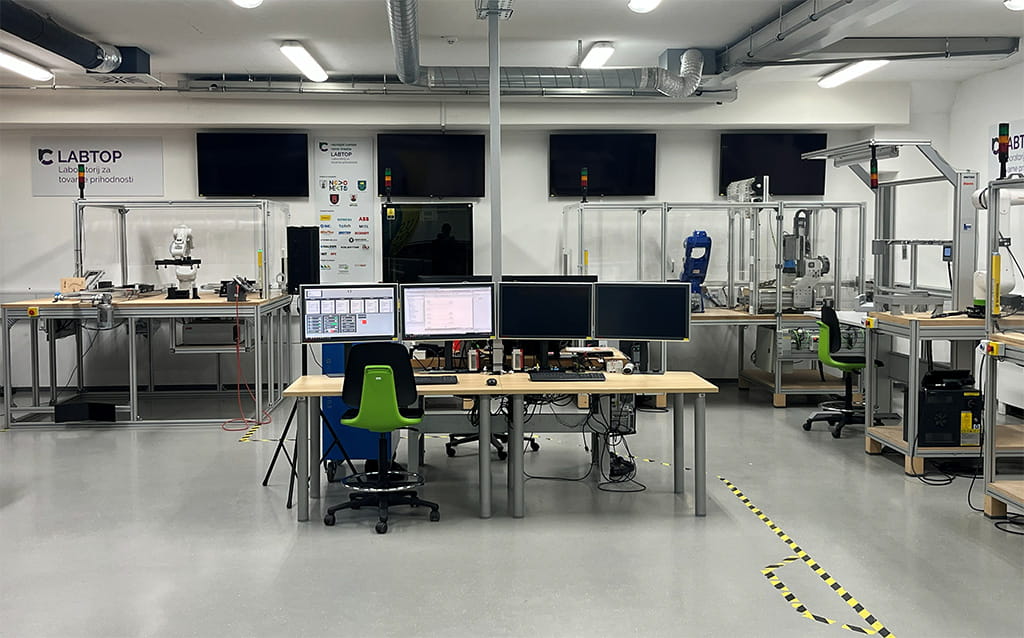
The paper addresses the development of energy digital twins for discrete manufacturing processes with the aim of improving energy consumption management. Due to increasing price volatility of energy sources and the demands of the green transition, accurate energy consumption forecasting is becoming crucial for maintaining companies’ competitiveness. A data-driven approach is presented that combines discrete-event modelling of the production process with a statistical description of repeatable energy consumption profiles of individual operations. First, consumption prototypes for individual operations are identified based on measurements, and then the production flow is modelled using stochastic Petri nets. By applying Monte Carlo simulations, it is possible to predict total energy consumption and evaluate its variability. The approach was demonstrated on the LabTop demonstration production line, where the results show a good match between predicted and actual energy consumption. The developed model enables time-dependent forecasting of consumption for different production plans and supports the optimization of production scheduling. Energy digital twins thus represent an important tool for reducing peak loads, improving energy efficiency, detecting anomalies, and supporting sustainable and adaptive management of industrial processes.
Keywords:
energy digital twin, production processes, discrete manufacturing, energy consumption forecasting, discrete-event modelling, stochastic Petri nets, Monte Carlo simulation, energy management, production optimization, industrial energy systems
Copyright (c) 2026 Miha Glavan, Rok Struna, Vinko Longar, Dejan Gradišar
This work is licensed under a
Creative Commons Attribution 4.0 International License.
Except where otherwise noted, articles in
this journal are published under the
Creative Commons Attribution 4.0 International License.