

Open Access – Statement
Scientific and professional articles in the journal Ventil are published in open access under the CC-BY-4.0 license. Authors are not charged for publishing the article.
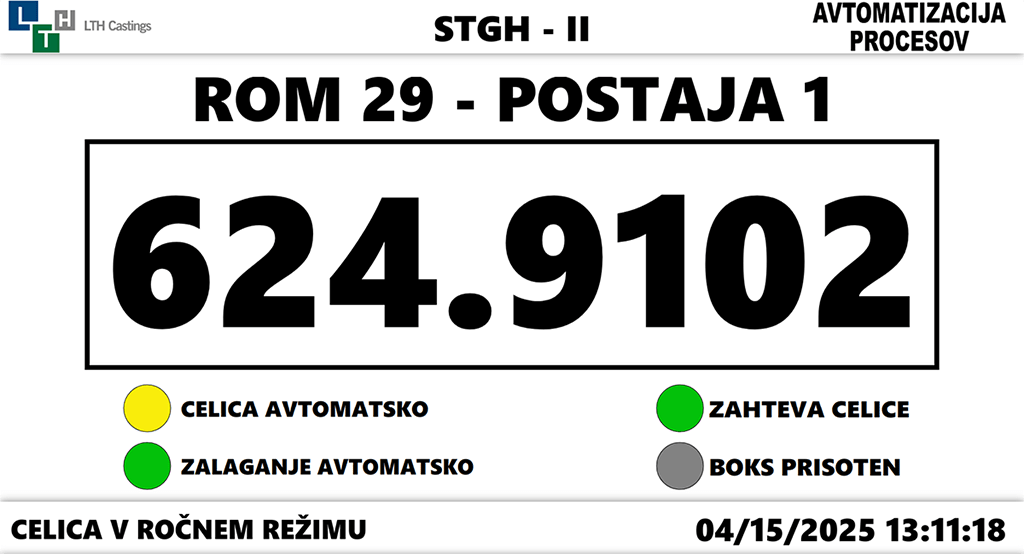
Use of Automated Guided Vehicle for Supplying Robotic Cells with Products
This paper presents the use of an Automated Guided Vehicle (AGV) for supplying robotic cells with products at LTH Castings d.o.o., a company that has been successfully expanding its business for many years while placing strong emphasis on investments in the automation of the production processes. Although the current level of automation is already high, further investments in this area are essential, as the rapid development of industry requires continuous upgrading and optimization.
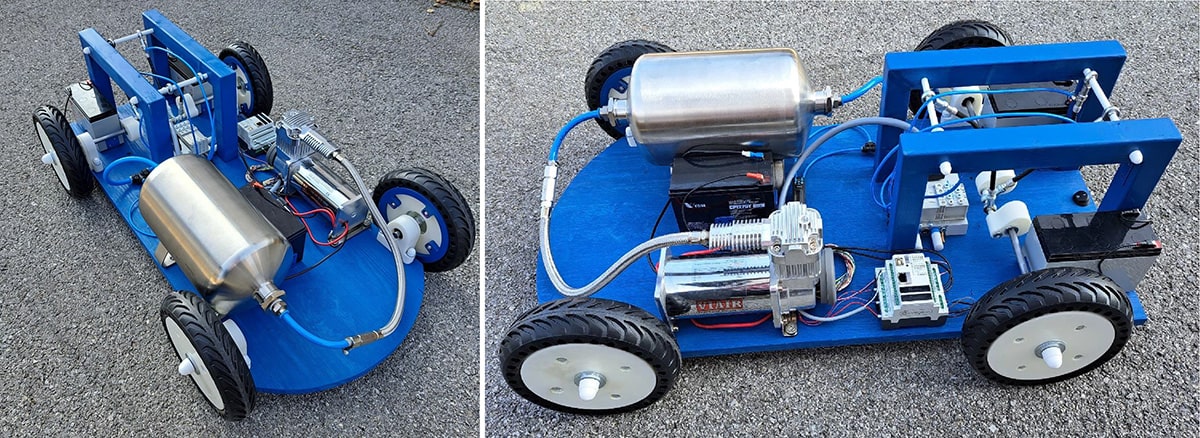
Application-Oriented Mechatronic Systems with Pneumatic Actuation
This paper introduces six novel mechatronic systems driven by pneumatic actuators, developed as instructional models aimed at enhancing the education of mechanical engineering students in pneumatic power systems and automatic control. The initial system presented is an autonomous vehicle prototype powered entirely by compressed air, utilizing pneumatic artificial muscles for propulsion.

Multi-agent path planning for a fleet of automated guided vehicles in industrial setting with charging stations
The paper presents an approach that enables efficient multi-agent path planning. The environment is described by a graph that represents a network of roads and crossroads for vehicles of different shapes and velocities. The multi-agent pathfinding approach is based on a safe interval path planning algorithm with priorities and safe locations, which together allow for lifelong operation.

Additive Technology in Practice: Test Analysis of a Hydraulic Valve with an Innovative Valve Plate
The study investigates the use of additive manufacturing technologies in the production of hydraulic components, focussing on 3D-printed valves and manifolds with integrated pressure sensors. Additive technologies such as Metal Binder Jetting (MBJ) and Selective Laser Melting (SLM) enable design freedom, component consolidation and optimisation of internal geometry to reduce pressure losses and mass.

Optimizing Production Layout and Logistics Using a Digital Twin at UNIOR
This paper presents the use of a digital twin as a key tool for optimizing layouts and internal logistics in the company UNIOR. Following the closure of one of its production units, it was necessary to relocate several machines and technologies to two existing locations, with the goal of achieving an efficient arrangement with minimal construction interventions.

PID tuning based on differential evolution algorithm in PLC for airflow control
The paper presents implementation of advanced algorithms in PLC using the higher-level programming language SCL for PID parameter tuning in process automation. Nowadays advanced algorithms can also be implemented directly in PLCs, whereas implementation of artificial intelligence and machine learning algorithms is particularly interesting.

Improved Time-Optimal Planning of Robotic Surface Finishing Using a Region-Based Approach
Traditional approaches to robotic surface machining often rely on a predefined, constant direction and speed of tool motion, regardless of the local characteristics of the workpiece. Such a uniform strategy results in inefficient utilization of the robot’s capabilities, particularly when dealing with complex geometries where the kinematic performance can vary significantly across different surface regions.

Robotic pipetting with the Andrew+ robotic system
This technical paper details the development of an application aimed at automating the pipetting process in pharmaceutical laboratories. The focus is on autonomous adapting of Onelab protocols for programming the Andrew+ robot.

Navigating the Modern Challenges of Implementing and Validating Computerized Systems in Pharma 4.0
The validation of computerized systems in the pharmaceutical industry is increasingly complex due to the rapid advancement of digital technologies. Ensuring compliance with Good Manufacturing Practices (GMP), Good Laboratory Practices (GLP), and data integrity (DI) standards requires structured documentation and adherence to regulatory guidelines, such as GAMP 5.

Connecting Industrial Equipment to a 5G Network
The introduction of 5G technology has started a transformative leap in connectivity, enabling seamless integration between existing and new devices in industrial environments. This connectivity solves some technological challenges of linking IT systems with manufacturing processes and offers greater flexibility, agility and efficiency. In industrial applications, 5G facilitates the remote monitoring of equipment, the optimization of logistical processes and the implementation of predictive maintenance, making it a cor- nerstone of smart manufacturing.